| Day |
Chapters & Strategies |
Topics |
| 1 |
Day One Strategy
Discovering where Business Analysis fits in the big picture and what the main tools are
|
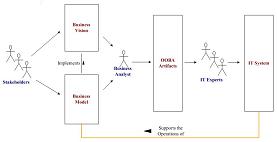
This first day covers the entire subject matter so that you get the big picture up front, a detailed road map on the overall methodology and real insights on all the artifacts you will use while performing UML Business Analysis (UML BA).
You begin with an introduction to the most important concepts and their ability to bring the two worlds together: Business (the Stakeholders Viewpoint) and IT.
The next step reveals the Stakeholders Viewpoint and how it creates the Business Vision and Business Model. You perform a lab and present a Business Vision by yourself. This is your opportunity to understand fully stakeholders and Business Experts because you will be thinking, speaking and performing like one of them for about an hour!
You then cover the IT (Information Technology) Viewpoint. You see the main topics that must be presented to IT experts so that they understand what they are supposed to build. At this point you can match the Business Viewpoint with the IT Viewpoint and you clearly understand which UML BA artifacts to use for that.
|
| 1 |
Overview
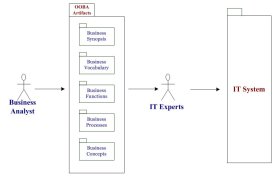
How the business viewpoint is represented with OO notation
|
- Course Objectives
- The Business Perspective
- The IT-compatible syntax
- Objects are just Business Concepts
- Business concepts, relationships and instances
- Main players, and the big picture
- Artifacts for Business Synopsis, Vocabulary, Functions, Concepts and Processes
- Self-summary and Exercise
|
| 1 |
Stakeholders Viewpoint
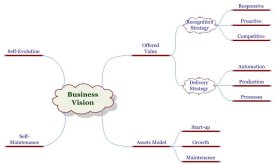
The Business value as seen by Stakeholders, Business Experts, or Sponsors
|
- Chapter Objectives
- The Business Vision Model
- Model
- Offered Value
- Assets Model
- Self-Maintenance
- Self-Evolution
- Business Vision lab
- The Business Model
- What goes into IT models and what doesn't
- How IT supports the Business Model
- How the Business Model supports the Business Vision
- Self-summary and exercise
|
| 1 |
IT Viewpoint
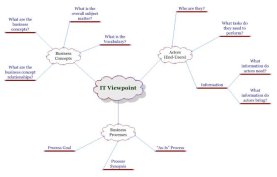
What must be given to IT Experts so that they can play their technical role
|
- Chapter Objectives
- IT Perspective
- Model
- Business Concepts
- Actors and what they do
- Business Processes
- Business Case: how a project may fail and why
- Lessons learned
|
| 1 |
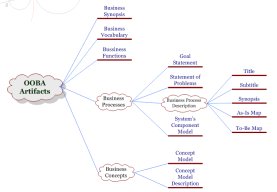
Bridging the Viewpoints
The approach and artifacts both sides clearly understand
|
- Chapter Objectives
- Artifacts Model-the big picture
- Artifact definitions
- Definition, Examples and Exercises for:
- Business Synopsis
- Business Vocabulary
- Business Functions
- Business Processes
- Business Concepts
- How the artifacts fulfill both the Business and the IT Perspectives
|
| 2 |
Day Two Strategy
First Modeling Experience
|
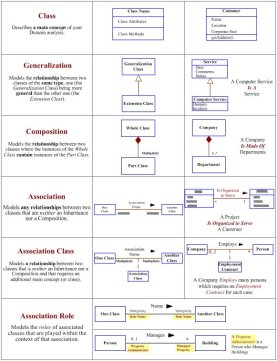
On this second day, you start off by learning Business Concept Modeling (BCM). This is by far the deepest and most powerful Analysis tool. Its outcome is a couple of artifacts (a diagram and a textual description) that capture and entirely describe the deepest business knowledge that underlies the entire Business Model. This artifact is far reaching, deep and unambiguous. It covers all the Business concepts, concept relationships, roles, policies and rules your Stakeholders care about. It is entirely business-oriented as well as 100% ready for IT Experts to use.
Now, the focus is on integrating all the knowledge you have gained so far. The Brokerage Model is your first opportunity to perform an entire Analysis cycle on a business case that approaches real-life complexity. You get an opportunity to model on your own as well as in a small group. Your group presents its own solution and learns from others as well as from the instructor(s).
All students are closely mentored: we ask them questions that direct or rectify their thinking towards successful modeling. Solutions are never given away, except by the end of the exercise where everyone has either discovered them or has come very close! Different types of solutions along with their conceptual business meanings are presented. At that point, people already feel that they know how to perform OO Analysis. They've solved a problem that is just slightly below average complexity. It's a very fulfilling step.
By the end of this very busy but fulfilling day, students feel they've acquired the fundamental skills to perform UML Business Analysis. They've also got a clear picture of the whole Analysis and Modeling process. They're enthusiastic and well prepared to deal with the next day's challenge.
|
| 2 |
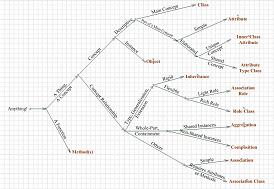
Business Concept Modeling (BCM)
The most powerful way to describe an organization's business concepts, rules and policies)
|
- Chapter Objectives
- Overview
- Examples
- Model Elements; Theory, Syntax, Examples and Exercises for:
- Business Concepts
- Class
- Business Concept Relationships
- Inheritance
- Composition
- Association
- Association Role
- Association Class
- BCM Decision Tree SM
- BCM Practice; an entire Business Domain
|
| 2 |
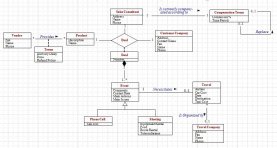
The Brokerage Model
Practicing Business Concept Modeling on a brokerage business case (Level 5)
|
- Exercise Objectives
- The five main artifacts
- Business Case
- Business Synopsis
- Business Functions
- Business Vocabulary
- Business Concept Model
- Diagram
- Textual Description
|
| 3 |
Day Three Strategy
Real-life Modeling Experience
|
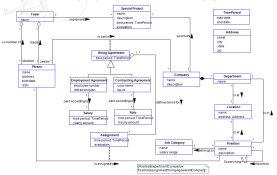
Thanks to the second day, students now possess the whole picture and the Brokerage Model has given them great confidence. It is time to deal with case studies that reflect real-life complexity. The third day's "Employee Model" brings about this opportunity. It is tackled in exactly the same way OO Analysis was performed on the previous day but it brings greater challenges. Students quickly discover that there exists a powerful dimension to modeling: the modeling of relationships. 75% of all the models' challenges reside in relationship modeling: inheritance, compositions, associations, association classes and roles. This is advanced modeling.
At least half of the day is devoted to letting (and helping) the students discover how to analyze this challenging problem domain and overcome all difficulties. Solutions come about through the persistent modeling of business concepts and their relationships. During this lab, people also learn how to ask the right questions that are beneficial to OO Analysis. They learn how to map all business concepts to classes, objects and their relationships.
After this exercise we consider that they can already go out and solve average real-life cases by themselves. They're already above average OO modelers.
|
| 3 |
The Employee Model
Practicing Business Concept Modeling on a more challenging business case (Level 6)
|
Exercise Objectives
The five main artifacts
- Business Case
- Business Synopsis
- Business Functions
- Business Vocabulary
- Business Concept Model
- Diagram
- Textual Description
|
| 4 |
Day Four Strategy
Professional and advanced modeling: solve anything at any time.
|
During the third day, students have learned how to "survive" real-life challenges through the advanced practice of relationship modeling.
At the start of the fourth day, the following question naturally comes up: Is there a way to tackle such models quickly? Yes there is; it is based on two key aspects: Analysis Patterns and Group Analysis Dynamics. Analysis Patterns are typical solutions to typical Analysis problems. Unless you use them, you'll be constantly re-inventing the wheel. Students learn the most fundamental analysis patterns and how to apply them on-the-fly.
Patterns are a higher-level modeling practice. With this technique one can model on-the-fly. Modeling on-the-fly here means the ability to quickly come up with solutions to complex problems while interviewing the domain experts. Several real-life (and non-confidential) case studies that we have dealt with during our own career at Object Discovery are used as patterns exercises. Three of them are so powerful and universal that they beautifully describe frameworks: a Scheduling Framework, a Product Configuration Framework and a Patient Tracking and Management Framework.
Frameworks are like super-patterns. They greatly simplify your Analysis work by using the Analysis patterns. Many of your models might only need a small extension of these frameworks.
We go over Group Analysts Dynamics too. These advanced techniques help the analyst channel and take advantage of the high energy and advanced knowledge of an entire group of subject-matter experts. All professional analysts have to deal with such groups soon or later. There are a few simple steps and behavioral rules that make you succeed in such environments. We cover them all while going through the many case studies explored in this day.
Students at this point feel that we've greatly shifted gears. They're getting ready to deal with any real-life challenges, including those they will encounter at their current work environment.
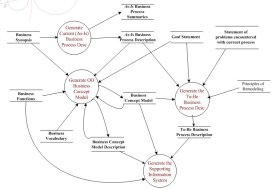
We then cover Object-oriented Business Process Modeling. It is based on the modeling of business concepts and processes using the same UML Analysis. You will complete Business Process Modeling projects much faster with this technology. It combines a set of modeling techniques and artifacts that perfectly complement each other. You can quickly describe and solve even very large or complex systems with these modeling techniques. You will then know how to manage, model and solve any business unit's processes--no matter the size. (Note: we would skip that chapter if your company is not involved with Business Processes).
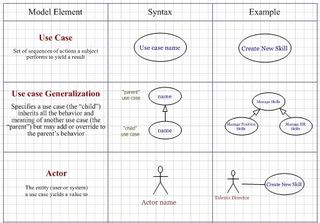
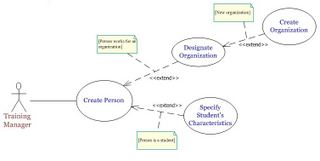
We also recommend covering Use Case Analysis, assuming your company would be committed to performing such models. When properly done they offer a very powerful, versatile abstraction to guide your UI designer and application engineers.
|
| 4 |
The Role Pattern
Solving more advanced business cases by modeling roles (Level 8)
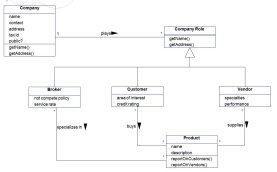
You will often encounter problems related to roles while performing UML BA. Roles are what any concept (or class) would play within the context of its related concepts (or classes). For instance a "company" would be the "supplier" of some specific "product". "Supplier" is a role. All role problems can be easily solved by selecting one of the following 5 role patterns: Role Inheritance, Association Roles, Role Classes, Generalized Role Classes and Association Class Roles. Each role pattern contains its own blend of power, flexibility and complexity. Together, they offer a complete solution to all role problems.
|
- Chapter Objectives
- The business problem with Roles
- Role Modeling Solutions Pros and Cons:
- Inheritance
- Association Role
- Role Class
- Generalized Role Class
- Association Class Role
- Association Class Role with Role Categories
- Real-life Business Case: Person's role in a complex business case
- Comprehensive exercise
|
| 4 |
The Composite Pattern (Optional)
Modeling hierarchies of compositions (Level 8)
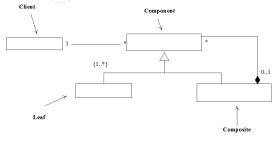
This is a very useful pattern that was first known as a Design Pattern, but it is an Analysis Pattern too. It has helped us solve many real-life case studies related to Manufacturing, Retail, HR Management, Medical, Financial and Insurance problem domains.
Like the Role Pattern it belongs to your UML Business Analysis "Survival Kit". This pattern gives you remarkable flexibility and very practical abstraction.
You will see an amazing case study we solved with Cummins Engines and their very bright engineers. The solution model is so powerful and generic that it is a Framework that can be used for many different types of configurable products, not just engines.
|
- Motivation
- Solution
- Meta-model
- A Manufacturing Framework Example
- The Product Composite Case
- The Product Composite Case
|
| 4 or 5 |
Group Analysis Dynamics (Optional)
How the professional analysts simultaneously lead and serve a group of subject-matter experts
|
- Start with the Business Synopsis and Vocabulary.
- Identify and invite the real experts
- Immediately model of every piece of information
- Dispatch knowledge to proper artifact(s)
- Use each expert's knowledge to build the BCM
- Describe each model in business terms to get feedback and consensus
- The reason why you will never get into "Analysis Paralysis"
- Model the best known concepts first
- Master all relationships modeling
- Apply patterns while meeting with the experts
- Get all the Subject Matter Experts' final approval
|
| 4 or 5 |
OO Business Process (Optional)
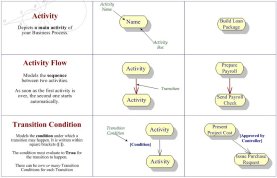
Solving challenging Business Process Problems using the power of Business Concept Modeling and Business Process Maps
|
- Chapter Objectives
- The IBM Credit Department Case Study
- OOBPM Principles
- OOBPM Artifacts
- Business Process Map
- The Ford Motor Company Case Study
- Comprehensive Exercise
- Conclusion
|
| 4 or 5 |
UML Use Case Analysis (Highly Recommended)
Modeling the user's and usage viewpoint from the proper level of abstraction
|
- The very unique philosophy of Use Cases
- Why people fail and how you will avoid the pitfalls
- Use Case Modeling Elements
- Use Case
- Use Case generalization
- Actor
- Actor generalization
- include
- extend
- The powerful extend condition syntax
- Reuse, modularity, clarity, abstraction, flexibilty
- Leveraging the Domain Model knowledge
- How Use Case diagrams differ from other diagrams
- Detecting all the possible options
- Favoring diagrams over text
- What Use Cases can do no other artifacts can
- What Use Cases should never be used for
- Making the model powerful but small
- When/how Use Cases can use other diagrams
- Comprehensive Exercise
- Conclusion
|
| 5 |
Day Five Strategy
Perform UML Business Analysis on your own environment: The Corporate Case Study
|
We consider that after the fourth day our students have become experts. It is now very exciting and rewarding to apply this whole expertise to a subject matter or project pertaining to the student's own work environment.
On the fifth day, you may bring a problem that you consider important (even mission-critical) and non-trivial. We start from a written short Business Synopsis and corresponding Business Vocabulary. Then we perform the whole UML Analysis as a group, involving the whole class. We complete all steps according to the principles and techniques that we've learned during the past four days.
You will see some of their most dreaded corporate problem domains melt away under the "powerful chisel" of professional UML Business Analysis. It gives the students great confidence, and we (instructors) get to see some of the greatest problems ever found in the field... and a first-hand opportunity to solve them.
Alternately and upon our clients request we can use this last day to review other topics or cover more of the optional ones.
|
| 5 |
Corporate Case Study (Optional)
Applying OO analysis and design to a problem at the students' company
|
- Prepare your case study
- Present the case study to the class
- Perform the Advanced Case Study (as described right above)
- Involve your organization's SMEs
- Present the results to your organization's SMEs and/or stakeholders
|
See how we differ from other training companies based on our
professional success, skills-building teaching techniques,
and Corporate Case Study. More details
here.